
The 2026 battery market is becoming more practical, diversified, and demanding. Large Capacity Lithium Battery systems now support electric vehicles, grid storage, marine equipment, data centers, and industrial backup power. Buyers are no longer asking only about capacity. They also examine thermal stability, charging speed, cycle life, weight, operating temperature, and long-term cost.
Battery scientist Jeff Dahn has emphasized, “The battery is the most important component in an electric vehicle.” His statement remains relevant for every large energy system. Lithium iron phosphate, or LFP, continues to attract attention because it offers strong safety, stable cycling, and competitive cost. Nickel-manganese-cobalt batteries still provide high energy density for vehicles needing longer range. Lithium manganese iron phosphate, known as LMFP, may offer a useful middle ground, although manufacturing consistency still requires careful evaluation.
Solid-state lithium batteries could bring higher energy density and improved safety. They are promising, but large-scale production remains difficult. Lithium titanate batteries charge quickly and perform well in cold conditions, yet their lower energy density limits some applications. High-nickel chemistries may store more energy in a smaller pack, but thermal management becomes more demanding.
No single chemistry wins every test. That matters.
In practice, the best Large Capacity Lithium Battery depends on the application, installation environment, maintenance plan, and safety requirements. Product labels can sound impressive. Real operating data matters more. This overview compares the leading 2026 battery types, while acknowledging an uncomfortable truth: predictions can change faster than factories can adapt.
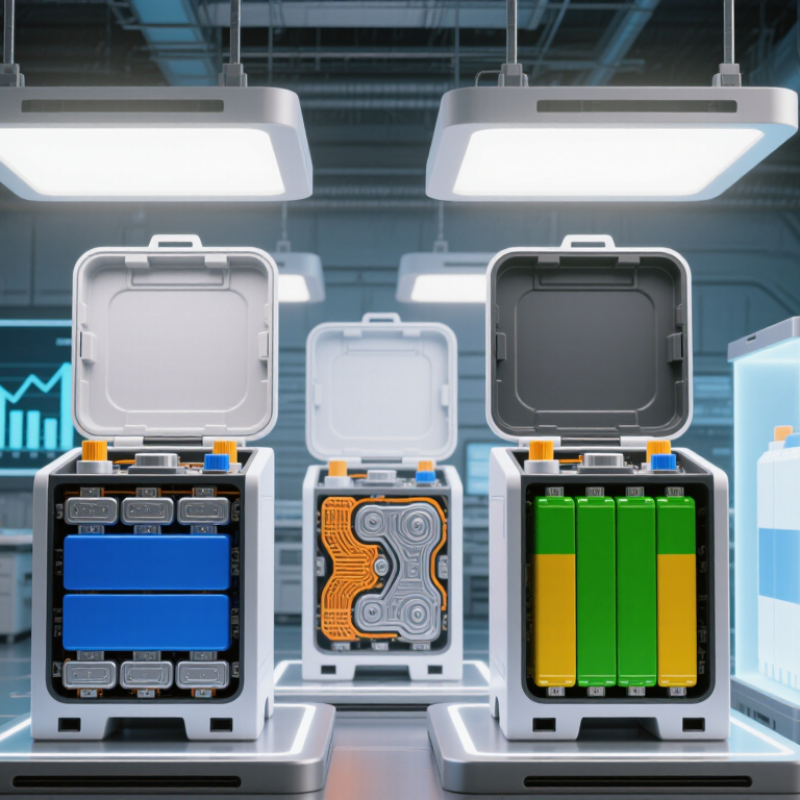
Large-capacity lithium batteries are commonly grouped by ampere-hours, or Ah. The 100–280 Ah class suits backup systems, small electric equipment, and compact solar storage. A 12.8V, 200 Ah battery stores about 2.56 kWh before losses. Lithium iron phosphate chemistry remains popular because it offers strong thermal stability and long cycle life. Its weight is also lower than comparable lead-acid systems.
The 300–600 Ah range supports larger inverters, mobile power units, and daily residential storage. A 51.2V, 400 Ah pack provides roughly 20.5 kWh of nominal energy. Engineers must check voltage, continuous current, cooling, and battery management system limits. Ah alone does not define performance. Field results vary.
Systems rated from 700 to 1,000+ Ah usually serve commercial storage, industrial equipment, and high-demand backup applications. These packs may use parallel modules, separate monitoring, and reinforced busbars. At 51.2V, a 1,000 Ah system reaches about 51.2 kWh nominally. Usable energy will be lower because of reserve limits, temperature, aging, and conversion losses. Capacity labels are not always perfectly comparable. A practical evaluation should examine tested discharge data, warranty conditions, installation records, and service procedures. One overlooked detail can distort the entire calculation.
In 2026, large-capacity lithium batteries mainly include LFP, NMC, and LTO chemistries. LFP leads stationary energy storage because it balances safety, cost, and service life. Typical cells provide about 160–210 Wh/kg, although pack-level density is lower after cooling, wiring, and protection hardware. That difference matters when planning a container or home storage room.
In practical installations, LFP systems commonly support 3,000–8,000 cycles under suitable operating conditions. Real results depend on temperature, charging speed, depth of discharge, and maintenance. A battery used gently at moderate temperatures may last longer. Heavy daily cycling can shorten its useful life. Numbers on a specification sheet are not promises. They need context.
Tips: Keep the battery within its recommended temperature range. Avoid storing it fully charged for long periods. Check usable capacity, not only nominal capacity. Ask for cycle-test conditions before comparing products. LTO offers faster charging and exceptional cycle life, but its lower energy density and higher cost can limit large projects. NMC may pack more energy into a smaller space, yet it usually demands stricter thermal management. LFP is not perfect. Its heavier footprint can challenge mobile applications, and cold-weather performance may decline without heating. Engineers should compare safety design, warranty terms, monitoring quality, and total lifecycle cost together. The best chemistry depends on the duty cycle, available space, and operating environment.
For 2026 large-capacity lithium systems, nickel-manganese-cobalt (NMC) cells remain attractive where stored energy matters most. Their typical gravimetric energy density ranges from 200 to 300 Wh/kg at cell level. This allows a lighter battery for electric mobility, backup equipment, and compact industrial storage. More usable energy can fit into the same enclosure. That advantage is practical, not merely theoretical. Yet pack-level density is lower after housing, cooling, wiring, and safety controls are included.
A realistic NMC cycle-life expectation is about 1,000 to 2,000 cycles, but the number needs conditions. Testing at moderate temperatures, controlled charging, and defined depth of discharge can produce better results. Daily operation at high temperatures or near full charge may accelerate capacity loss. Fast charging can also increase heat and stress when thermal management is weak. Numbers need context. A 2,000-cycle claim does not guarantee 2,000 full cycles in every installation.
For procurement, examine cell-level and system-level figures separately. Ask for capacity-retention data, test temperature, charge rate, discharge rate, and end-of-life threshold. Independent laboratory reports are more useful than attractive headline specifications. In field experience, conservative operating limits often protect performance better than chasing maximum range. NMC also requires careful monitoring because thermal events can escalate when design controls fail. The chemistry is capable, but it is not forgiving. Some published figures may look precise while hiding assumptions. That is where technical review matters.
NMC cathode chemistries can provide approximately 200–300 Wh/kg at the cell level, with typical cycle-life ranges of about 1,000–2,000 cycles. Higher-nickel variants generally offer greater energy density, while lower-nickel formulations tend to provide better thermal stability and cycle durability. Actual performance depends on cell design, operating temperature, charge rate, and depth of discharge.
What Are the 2026 Top Large Capacity Lithium Battery Types?
For 2026, LMFP and LTO deserve close attention in large-capacity battery systems. LMFP typically delivers 180–240 Wh/kg at the cell level. That higher density supports longer driving range and smaller storage enclosures. In a 100 kWh pack, every kilogram saved can improve vehicle payload or cooling space. Real results still depend on packaging, temperature, and operating limits.
LTO usually provides 70–90 Wh/kg, which is considerably lower. It gives up compactness for exceptional durability and charging performance. Properly managed LTO cells can exceed 5,000 cycles. Some systems may achieve more, but test conditions matter greatly. A delivery vehicle making several daily routes could benefit from this cycle strength. Rapid charging and strong low-temperature performance also reduce operational delays. Space matters.
From practical evaluations, thermal management often influences results more than datasheet figures. A poorly cooled LMFP pack may age faster than expected. An oversized LTO installation may become expensive and difficult to place. These are easy points to miss. Buyers should compare usable energy, cycle depth, charging speed, and replacement access. Cell-level energy density should not be confused with pack-level density. That comparison remains imperfect, but it is more honest.
LMFP and LTO comparison: energy density, cycle life, charging performance, safety, and practical use cases
| Battery Type | Positive / Negative Electrode | Typical Cell-Level Energy Density | Nominal Cell Voltage | Typical Cycle Life* | Fast-Charging Capability | Thermal and Safety Characteristics | Main Advantages | Main Limitations | Suitable Large-Capacity Applications |
|---|---|---|---|---|---|---|---|---|---|
| LMFP (Lithium Manganese Iron Phosphate) |
Lithium manganese iron phosphate cathode / graphite or graphite-silicon anode | Approximately 180–240 Wh/kg, depending on cell design, active-material ratio, and pack configuration | Approximately 3.6–3.7 V | Approximately 2,000–4,000 cycles to around 80% remaining capacity under suitable operating conditions | Generally good; commonly engineered for high-power charging, with charging speed dependent on the cell design, cooling system, and battery-management system | Strong thermal stability and lower oxygen-release risk than nickel-rich layered cathodes; protection against overcharge, overheating, and mechanical damage is still required | Higher energy density than conventional LFP; good thermal stability; reduced dependence on nickel and cobalt; suitable for balancing range and cost | Usually lower low-temperature power and energy performance than some nickel-rich chemistries; manganese-related voltage and aging behavior require careful formulation and control | Electric vehicles, commercial vehicles, stationary energy storage, backup-power systems, and large battery packs where moderate-to-high energy density is important |
| LTO (Lithium Titanate) |
Lithium titanate anode / commonly lithium manganese oxide, NMC, or related cathode materials | Approximately 70–90 Wh/kg at cell level | Approximately 2.3–2.4 V | Typically 5,000–20,000+ cycles; actual life depends on depth of discharge, temperature, charging rate, and end-of-life criteria | Excellent; designed for very high charging and discharging power, with charging times potentially measured in minutes when the system and grid connection support it | Very low risk of lithium plating during fast charging; strong thermal stability and good tolerance to high-power operation; complete system-level safety controls remain necessary | Extremely long service life; excellent fast-charging performance; high power capability; strong low-temperature charging behavior; low maintenance frequency | Low energy density, higher initial material cost, and a larger or heavier pack for the same stored energy; lower cell voltage requires more cells in series | Fast-charging buses, high-cycle industrial vehicles, grid-frequency regulation, renewable-energy buffering, power tools, and applications requiring frequent rapid charge and discharge |
| LMFP vs. LTO: Energy Priority | LMFP uses a higher-voltage phosphate cathode system, while LTO replaces the conventional graphite anode with lithium titanate | LMFP generally stores about two to three times more energy per kilogram than LTO at cell level | LMFP has a higher nominal voltage, which helps reduce the number of series-connected cells for a given system voltage | LTO generally provides the longer cycle-life margin, especially in high-frequency, high-power operation | LMFP offers strong fast-charging potential; LTO is generally better suited to repeated extreme-power charging | Both chemistries can provide strong safety performance when supported by appropriate cell design, thermal management, and battery-management controls | LMFP is better when usable energy, pack weight, and driving or backup duration are priorities; LTO is better when power and service life dominate | Neither chemistry is optimal for every duty cycle: LMFP may not match LTO for extreme cycling, while LTO requires more mass and volume for the same energy capacity | Selection should be based on energy requirement, power demand, charging time, operating temperature, space, lifecycle cost, and maintenance strategy |
*Cycle-life figures are typical engineering ranges rather than guaranteed results. Actual performance varies with cell format, charging voltage, charging rate, depth of discharge, temperature, storage conditions, balancing accuracy, and the definition of end of life. Energy-density figures refer primarily to cell-level values; complete battery-pack values are lower after adding modules, cooling, housing, busbars, sensors, and safety components.
Solid-state lithium batteries are moving from laboratory ambition toward limited commercial readiness in 2026. Their headline target exceeds 300 Wh/kg at cell level, potentially reducing battery weight and increasing driving range. However, pack-level energy density will remain lower after adding cooling systems, casing, wiring, and safety controls.
The U.S. Department of Energy’s Battery500 Consortium set a long-term target of 500 Wh/kg for lithium battery cells. This benchmark shows how demanding the engineering challenge remains.
The International Energy Agency reported that global electric-vehicle battery demand surpassed 1 TWh in 2024. That scale increases pressure for safer, denser, and more durable chemistries. Yet solid electrolytes still face interface resistance, manufacturing uniformity, and cycle-life problems.
Commercial readiness will likely appear in stages. Limited pilot production may support premium applications before mass-market vehicles. IDTechEx’s solid-state battery research highlights manufacturing scale-up as a central barrier, not merely electrolyte performance. In practical testing, a cell must survive vibration, rapid charging, temperature changes, and thousands of operating cycles. A small laboratory pouch can look impressive. A factory line is less forgiving. The 300+ Wh/kg goal therefore deserves cautious confidence, not automatic acceptance. Some projections may also overlook yield losses and energy consumption during production. For 2026, the strongest evidence will be independently verified pilot data, stable cycling results, and transparent cost measurements.
They are commonly grouped by ampere-hours, or Ah. The main ranges are 100–280 Ah, 300–600 Ah, and 700–1,000+ Ah. Ah shows storage capacity, but not complete performance.
A 12.8-volt, 200 Ah battery stores about 2.56 kWh nominally. It may support backup equipment, small electric devices, or compact solar storage. Usable energy will be lower after losses.
This range can support larger inverters, mobile power units, and daily home storage.
These systems often serve commercial storage and industrial equipment. They can support demanding backup applications. Large installations may use parallel modules, separate monitoring, and reinforced busbars.
It balances thermal stability, cost, and service life. Typical cells provide about 160–210 Wh/kg. Pack-level density is lower after wiring, cooling, and protection hardware.
Some storage systems support roughly 3,000–8,000 cycles under suitable conditions. Temperature, charging speed, discharge depth, and maintenance all matter. Specification numbers are not promises.
No. Reserve limits, aging, temperature, and conversion losses reduce usable energy.
Compare voltage, continuous current, cooling, monitoring, and protection limits. Review tested discharge data, warranty conditions, installation records, and service procedures. One missed detail can distort the entire calculation.
Lithium titanate supports fast charging and exceptional cycle life. Its energy density is lower, and its cost may be higher. Nickel-rich chemistry can save space but needs stricter thermal management.
Cold weather can reduce performance without battery heating. Heavy daily cycling may shorten service life. I might still underestimate site conditions. Field results vary.
In 2026, the Large Capacity Lithium Battery market is defined by cells and systems ranging from 100 Ah to more than 1,000 Ah, serving energy storage, electric mobility, and industrial applications. Lithium iron phosphate (LFP) remains a leading choice for stationary storage because it offers strong safety, approximately 160–210 Wh/kg energy density, and a long service life of around 3,000–8,000 cycles. Nickel manganese cobalt (NMC) batteries provide higher energy density, generally about 200–300 Wh/kg, making them suitable where weight and space are important, although their typical cycle life is approximately 1,000–2,000 cycles.
Other emerging options also have distinct advantages. LMFP aims to improve energy density while retaining much of LFP’s durability, reaching roughly 180–240 Wh/kg. Lithium titanate (LTO) has lower energy density at about 70–90 Wh/kg, but can deliver exceptionally fast charging and more than 5,000 cycles. Solid-state lithium batteries target over 300 Wh/kg and may begin limited commercial adoption in 2026, depending on manufacturing maturity, cost, and reliability.
